Welcome to today’s blog post where we delve into an intriguing mathematical problem: determining whether a given non-negative integer can be expressed as the sum of two square numbers. This problem is a classic example of how mathematics and computer science can intersect to solve real-world problems efficiently.

If you’re just joining us, it might be helpful to catch up on the previous entries. Want to see more problem-solving techniques? Follow me here on my blog!
Understanding the Problem#
The problem is to determine if there exist two non-negative integers, a and b, such that the equation a^2 +b^2 = c holds true for a given non-negative integer c.
Problem Definition#
Given a non-negative integer c, decide whether there are two integers a and b such that a^2 +b^2 = c
Example 1:
Input: c = 5
Output: true
Explanation: 1 * 1 + 2 * 2 = 5
Example 2:
Input: c = 3
Output: false
Using Efficient Approach 1 (Two-Pointer Approach)#
One efficient way to solve this problem is by using a two-pointer technique. This approach leverages the properties of squares and aims to reduce the number of calculations needed to determine if the condition is met.
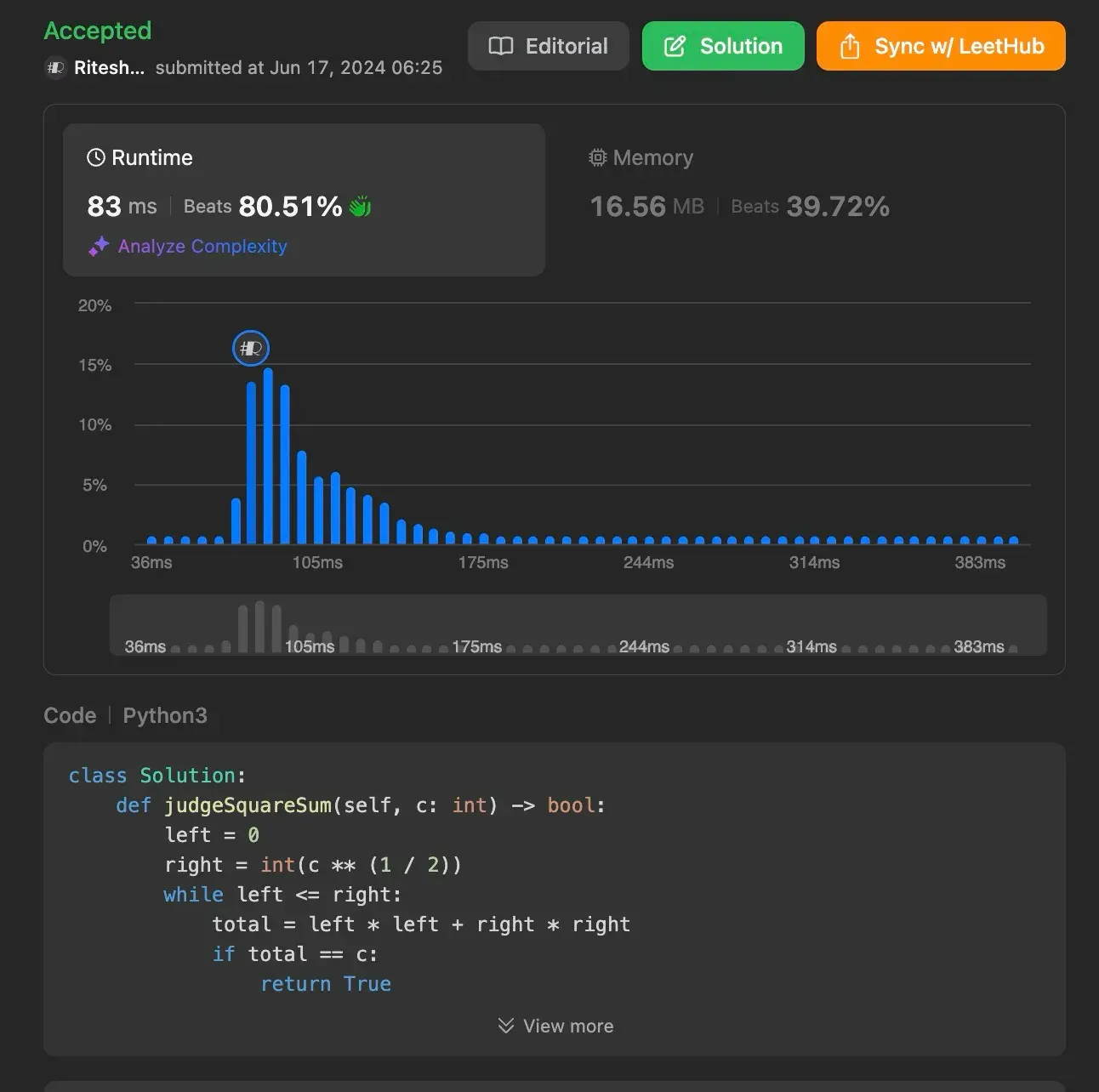
def judgeSquareSum(self, c: int) -> bool:
left = 0
right = int(c ** (1 / 2))
while left <= right:
total = left * left + right * right
if total == c:
return True
elif total > c:
right -= 1
else:
left += 1
return False
Explanation#
- Initialization: We start with two pointers:
leftinitialized to0andrightinitialized to the integer square root ofc. - While Loop: The loop runs as long as
leftis less than or equal toright. - Calculation: For each iteration, compute the sum of the squares of
leftandright. - Comparison:
- If the sum equals
c, returnTrue. - If the sum is greater than
c, decrement therightpointer. - If the sum is less than
c, increment theleftpointer.
- If the sum equals
- Termination: If no valid pair is found, return
False.
Time Complexity: 𝑂(√𝑐) – The algorithm performs a linear scan up to the square root of c.
Space Complexity: O(1) – The algorithm uses a constant amount of extra space.
Using Efficient Approach 2 (Fermat’s Theorem)#
This approach is based on Fermat’s Theorem, which states:
Any positive number
nis expressible as a sum of two squares if and only if in the prime factorization ofn, every prime of the form4𝑘 + 3occurs an even number of times.
By using this theorem, we can directly determine if the given number c can be expressed as a sum of two squares.
Algorithm#
- Find all prime factors of the given number
c, which could range from [2,√𝑐], along with the count of those factors, by repeated division. - If at any step, we find that the number of occurrences of any prime factor of the form
4𝑘 + 3is odd, returnFalse. - If
citself is a prime number and of the form4𝑘 + 3, return False. - Otherwise, return
True.
The proof of this theorem includes the knowledge of advanced mathematics and is beyond the scope of this article. However, interested reader can refer to this documentation.
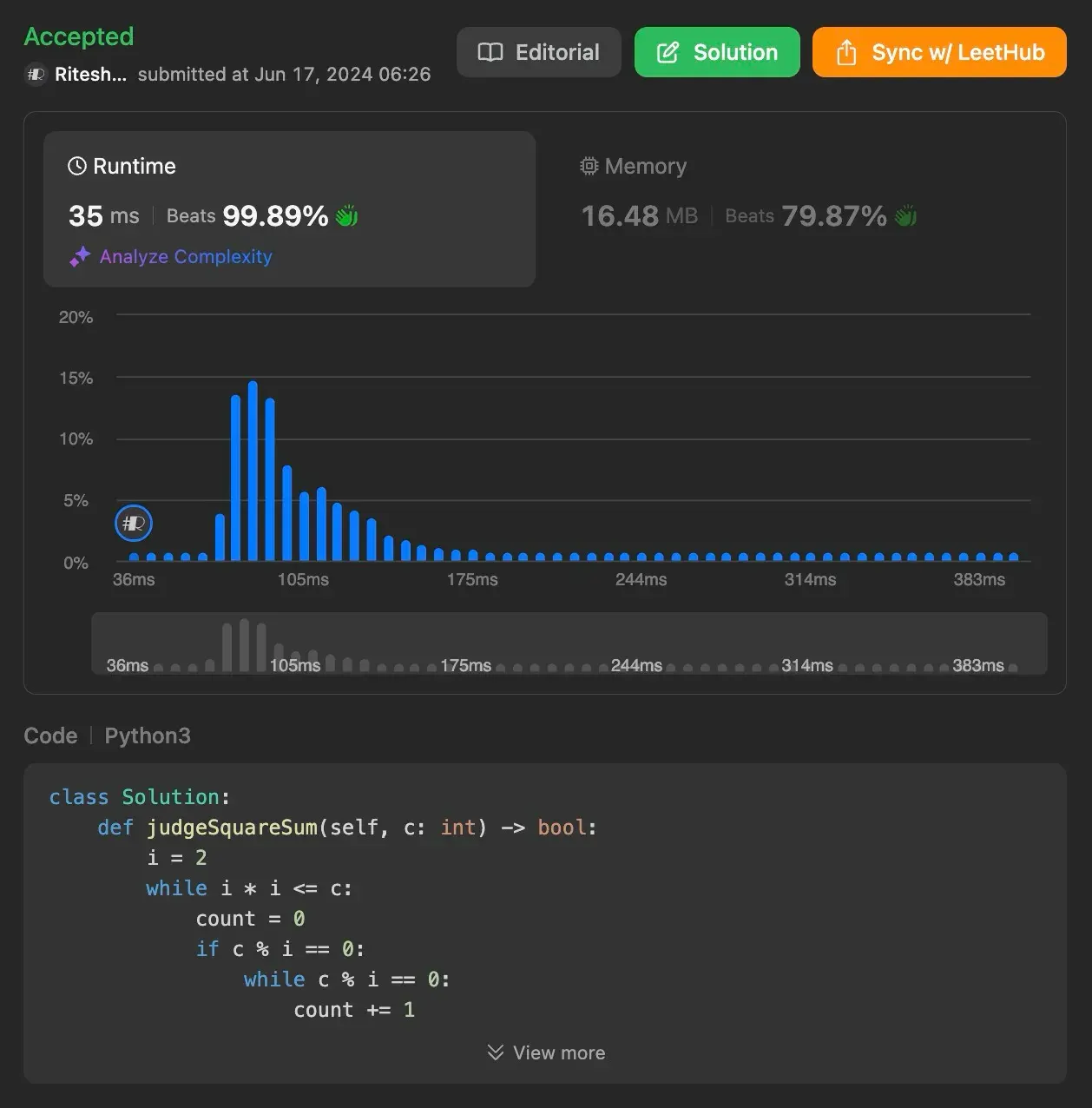
def judgeSquareSum(self, c: int) -> bool:
i = 2
while i * i <= c:
count = 0
if c % i == 0:
while c % i == 0:
count += 1
c //= i
if count % 2 and i % 4 == 3:
return False
i += 1
return c % 4 != 3
Explanation#
- Initialization: Start with
iinitialized to2. - While Loop: The loop runs as long as
i * iis less than or equal toc. - Prime Factorization: For each
i, count how many timesidividesc. - Validation:
- If
i % 4 == 3and the count ofiis odd, returnFalse.
- If
- Termination: After processing all factors, check if the remaining c is of the form
4𝑘 + 3. If so, returnFalse; otherwise, returnTrue.
Time complexity : O(√c x logc). We find the factors of c and their count using repeated division. We check for the factors in the range [0,√c].
The maximum number of times a factor can occur (repeated division can be done) is logn(considering 2 as the only factor, c=2^x. Thus, x=logc).
Space complexity : O(1). Constant space is used.
Conclusion#
In this post, we explored two efficient approaches to determine if a given non-negative integer can be expressed as the sum of two square numbers. The two-pointer technique and the approach based on Fermat’s Theorem both provide efficient solutions with their unique advantages.
Understanding these methods enhances your problem-solving skills and prepares you for tackling similar challenges in coding interviews and competitions.
Found this helpful? Follow me for more leetcode adventures! Questions? React out via email.